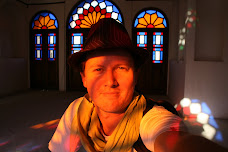
Alex and were joined by Serena, a Malaysian lawyer on the way to an internship with the UN in New York, whom we meet the previous day, for the trip to Palmyra in the mid-east of Syria – on the road to the border with Iraq. I sat on the back seat with a family from Dehr-ul Doon (right on the border) who told me of the town’s difficulties from the influx of Iraqis fleeing the conflict and invited me to stay. We got in quite late to the Sun Hotel and managed to arrange a taxi for the next day’s exploration of the legendary pink city.
A bugger early start took us to the Arab Castle (Qala’at ibn Maan) for sunrise and a magnificent view over the plain of Palmyra, a city that rivals Petra and Angkor Wat. Palmyra started off as an Assyrian caravan stop for the Silk Road, then grew to glory under the Greeks and was annexed by Rome in AD217. The taxi dropped us back at the hotel and after a power snooze we walked to the main ruins along the dusty roads. Highlights at Palmyra were:
* Temple of Baal Shamin: with its inner sanctum and sunken passage for animal sacrifices.
* Monumental Arch: actually two arches built on 30 degree angle to mask kink in road.
* Main street: glorious row of columns, flanked by theatre and blocked by the Camp of (Roman) Diocletian.
* Towers of Yemliko: multi-story burial chambers that look like a giant has plonked them in the sand.
* Hypogeum of 3 Brothers: underground burial chamber with amazing frescoes and big wooden door needing giant brass key.
As sunset fast approached, we slogged our way across the sandy desert back to the foot of the Arab Castle and raced (scrambled) for the top. Alex went straight up the steep rocky slope and was very impressive but I followed a local shepherd up the windy path to the left and beat Alex there (ha!) – not that I am competitive. After the glorious sunset, utterly knackered and close to complete dehydration we hitched a ride back to town with a Polish tour group and fed ourselves then crashed. Tomorrow back to Damascus for final days in Syria.
Wednesday, 3 October 2007


Hama (Syria): Muslim Brotherhood, Syrian dating, Apamea and Crac Des Chevaliers (9-10 Aug)
A town renowned for its huge water wheels, Hama appeared rather sleepy but a brief reading of its recent history reveals another story – most of the old city was destroyed in a huge battle between government forces and the terrorising Muslim Brotherhood, which some say caused over 3,000 deaths. Despite this, the water wheels are indeed magnificent and produce a continuous loud groaning as they turn. Walking back to our side of town, we stopped to buy one of everything in a chocolate shop, ably helped by Wael Dabbag, a young guy keen to practice his English.
We invited Wael to join us for a tea and nargileh and found a nice table overlooking the Orontes River in the centre of town. We soon found out that not only did he not like the Internet due to its corrupting influences, but was suffering from a broken heart. He had been wooing a girl and had decided to marry her, but had only spoken to her a handful of times. He made his decision based on observing and “testing” her behaviour in the university café and by sending his mother to meet her family. However, it was now all off as he had seen the girl in the company of her “ugly man” cousin and was convinced that she was doing that to taunt him and that just wasn’t on. Great banter all round.
Around Hama:
Apamea – a medium size desert granite city constructed on wild, grassy moor overlooking the Al-Ghab plain. Apamea was founded in 2nd century BC by Seleucus I, one of Alexander the Great’s generals with inspiring main street flanked by columns, baths, churches and villas. Nearby is the Qala’at al-Mudiq – a medieval castle with tiny village crammed inside.
Crac Des Chevaliers: built in the 12-13th centuries by the Crusaders to defend against the Muslim hoards, this is definitely the most extraordinary and striking castle I have ever seen. The road there winds its way up and around hills and valleys until the huge structure rears up from atop a mountain. The castle must have really sapped the spirits of those Muslim hoards – it has 13 towers and if you managed to cross the moat and penetrate the tall, vertical walls, you would then face the inner castle with separate moat and even thicker walls.
Inside is a complete town with imposing towers and underground baths, chambers, storehouses plus Gothic facades and a church then converted into a mosque. Legend has it they could have held out for years but gave up after only a few months. One cool thing was a local boy singing the azan (call to prayer) under a niche inside the castle walls – brilliant acoustics.
That night we had a rather refined discussion on Dawkins’ ‘The God Delusion’ and much more.
We invited Wael to join us for a tea and nargileh and found a nice table overlooking the Orontes River in the centre of town. We soon found out that not only did he not like the Internet due to its corrupting influences, but was suffering from a broken heart. He had been wooing a girl and had decided to marry her, but had only spoken to her a handful of times. He made his decision based on observing and “testing” her behaviour in the university café and by sending his mother to meet her family. However, it was now all off as he had seen the girl in the company of her “ugly man” cousin and was convinced that she was doing that to taunt him and that just wasn’t on. Great banter all round.
Around Hama:
Apamea – a medium size desert granite city constructed on wild, grassy moor overlooking the Al-Ghab plain. Apamea was founded in 2nd century BC by Seleucus I, one of Alexander the Great’s generals with inspiring main street flanked by columns, baths, churches and villas. Nearby is the Qala’at al-Mudiq – a medieval castle with tiny village crammed inside.
Crac Des Chevaliers: built in the 12-13th centuries by the Crusaders to defend against the Muslim hoards, this is definitely the most extraordinary and striking castle I have ever seen. The road there winds its way up and around hills and valleys until the huge structure rears up from atop a mountain. The castle must have really sapped the spirits of those Muslim hoards – it has 13 towers and if you managed to cross the moat and penetrate the tall, vertical walls, you would then face the inner castle with separate moat and even thicker walls.
Inside is a complete town with imposing towers and underground baths, chambers, storehouses plus Gothic facades and a church then converted into a mosque. Legend has it they could have held out for years but gave up after only a few months. One cool thing was a local boy singing the azan (call to prayer) under a niche inside the castle walls – brilliant acoustics.
That night we had a rather refined discussion on Dawkins’ ‘The God Delusion’ and much more.
Lattakia (Syria): beach, fortune telling and the oldest alphabet in the world (6-8 Aug).
Alex and I grabbed the bus for three hours west to the Syrian part of the Mediterranean Sea. Lattakia is known as a more liberal town, perhaps due to an extended American presence of which only bad restaurants and a few streets remain. Lattakia also has great coffee. The priority was the beach so one morning we jumped in a minibus to Wadi Qandil, 30km north of the city for a much needed frolic in the sea and several hours watching families, girls in bikinis (shock, horror!) and feasting on roast chicken and a huge spread of salads and dips followed by nargileh. The next day we headed for the even more ancient city of Ugarit, which has been reduced to rubble but carries the impressive claim of being the site of the first alphabet ever recorded (16-15th century BC).
Alex and I grabbed a drink from a nearby stall in front of a family house and fell into conversation with the family who we noticed were reading their fortunes in their coffee grounds. Introducing Alex as an expert in reading fortunes, we spent the next hour creating fabulous futures from very small hints of fact, through the best translating efforts of their daughter, including that the young man was to have a challenging but rewarding time on his next journey which turned out to be military service.
From Ugarit we hitchhiked to the sea again and found a tiny village where we plonked ourselves under the shade of an umbrella and lunched all afternoon, chatting to the café owner who emotionally told his story of his son from his first marriage, who he hasn’t seen in 15 years and who is now living in Switzerland. A wonderful lazy day.
Alex and I grabbed a drink from a nearby stall in front of a family house and fell into conversation with the family who we noticed were reading their fortunes in their coffee grounds. Introducing Alex as an expert in reading fortunes, we spent the next hour creating fabulous futures from very small hints of fact, through the best translating efforts of their daughter, including that the young man was to have a challenging but rewarding time on his next journey which turned out to be military service.
From Ugarit we hitchhiked to the sea again and found a tiny village where we plonked ourselves under the shade of an umbrella and lunched all afternoon, chatting to the café owner who emotionally told his story of his son from his first marriage, who he hasn’t seen in 15 years and who is now living in Switzerland. A wonderful lazy day.
Banter with President Bartlett - aka Martin Sheen (Aleppo, Syria - 3 Aug)
Alex and I were quietly sipping Lebanese beer and enjoying a nargileh in the Sissi Bar of the Christian quarter of Al-Jdeidah. I spied a familiar face in a group leaving and jumped ten metres in the air when I realised it was none other than Martin Sheen - or President Josiah Bartlett to West Wing fans. I approached him and soon we were talking about the archeological dig he was visiting, the fact that he loved speaking Latin in WW and our travel exploits. Fantastic!


Aleppo (Syria): queens of the souqs, Iraqi wedding, Qala’at Samaan and the Dead Cities (3-6 Aug)
After a few days in Damascus, I hopped on a bus which took me the five hours north up the middle of Syria to the city of Aleppo (Haleb to locals). Spent a good hour or two trying to find the centre of town as a ceramics exporter I met on the bus was determined to help me despite not knowing his way at all around Aleppo. Checked into the Gawaher Hotel, behind the clock on the main square. Hit the internet café and met the dashing Alex, a young English/Turkish actor studying literature in York. Alex had just had a nightmare border crossing from Turkey and we agreed to meet for dinner. Alex turned out to be a brilliant man of banter and we travelled for the next 2 weeks and developed quite the wicked combination.
We headed for Al-Jdeida, the Christian Quarter, for beers and food. The only place with any life was the Sissi House, a gorgeous and Syrian-posh restaurant and bar, where we spent every night in Aleppo. LP claimed the Sissi had a piano bar, which of course was closed during summer (!) but this didn’t stop Alex having a delightful tinkle on the ivories. Each night we positioned in the bar section for beers and nargileh, and one night even stumbled upon an Iraqi wedding party complete with Turkish belly dancer.
Highlights from Aleppo and surrounds:
Citadel: almost every city of any size has one but Aleppo’s is the most impressive. It was built on a mammoth 45 degree hill with a huge moat, imposing 12th century wooden gate, Ottoman barracks and an entire city crammed within its walls and fabulous views over all of Aleppo.
Souqs: the best in Syria for wandering and chatting, where I managed to find lovely cotton-cotton sheets (better than Egyptian) and ample supplies of the legendary Aleppo olive oil soap. I bantered with the queens of the souqs – Syrian guys living a few months of the year in Melbourne – who dazzle French, Italian and Japanese tourists with their performances of exquisite shawls and other finery.
Great Mosque: with its huge free standing minaret and venerated holy relic – the head of Zacharius, father of John the Baptist.
Qala’at Samaan and the Dead Cities: with William Dalrymple’s ‘From the Holy Mountain’ tucked firmly under my arm, we toured the ancient ghost cities of Serjilla and Al-Bara, built by the Byzantines in the 6th century. Amazing ruins of churches, community halls and villas. Serjilla also had ancient olive presses, ovens and exposed sarcophagi –some buildings now occupied by shepherds. Al-Bara has two pyramid style tombs and kids eager to scramble over the ruins with us. The final stop was the Qala’at Samman (Basilica of St Simeon) set on a windy mountain overlooking the plains below. St Simeon was a stylite (self punishing acetic monk) who is reported to have stood on a 10 metre tall pillar for 15 years! The ruins included monks’ quarters for 600, massive church façade and arches surrounding an octagonal courtyard.
We headed for Al-Jdeida, the Christian Quarter, for beers and food. The only place with any life was the Sissi House, a gorgeous and Syrian-posh restaurant and bar, where we spent every night in Aleppo. LP claimed the Sissi had a piano bar, which of course was closed during summer (!) but this didn’t stop Alex having a delightful tinkle on the ivories. Each night we positioned in the bar section for beers and nargileh, and one night even stumbled upon an Iraqi wedding party complete with Turkish belly dancer.
Highlights from Aleppo and surrounds:
Citadel: almost every city of any size has one but Aleppo’s is the most impressive. It was built on a mammoth 45 degree hill with a huge moat, imposing 12th century wooden gate, Ottoman barracks and an entire city crammed within its walls and fabulous views over all of Aleppo.
Souqs: the best in Syria for wandering and chatting, where I managed to find lovely cotton-cotton sheets (better than Egyptian) and ample supplies of the legendary Aleppo olive oil soap. I bantered with the queens of the souqs – Syrian guys living a few months of the year in Melbourne – who dazzle French, Italian and Japanese tourists with their performances of exquisite shawls and other finery.
Great Mosque: with its huge free standing minaret and venerated holy relic – the head of Zacharius, father of John the Baptist.
Qala’at Samaan and the Dead Cities: with William Dalrymple’s ‘From the Holy Mountain’ tucked firmly under my arm, we toured the ancient ghost cities of Serjilla and Al-Bara, built by the Byzantines in the 6th century. Amazing ruins of churches, community halls and villas. Serjilla also had ancient olive presses, ovens and exposed sarcophagi –some buildings now occupied by shepherds. Al-Bara has two pyramid style tombs and kids eager to scramble over the ruins with us. The final stop was the Qala’at Samman (Basilica of St Simeon) set on a windy mountain overlooking the plains below. St Simeon was a stylite (self punishing acetic monk) who is reported to have stood on a 10 metre tall pillar for 15 years! The ruins included monks’ quarters for 600, massive church façade and arches surrounding an octagonal courtyard.
Sharing a steam room with the First Lady of Syria
As I walked in and out of the rooms of the Azem Palace in the old city, I noticed that a crowd had gathered near the main entrance. Soon a striking young woman entered the courtyard, flanked by dozens of security guards, minders, photographers, TV crews and adoring onlookers. Assuming she was a film star, I asked a guard and was told “She is President’s family” and another chimed in that it was his wife.
I decided to continue exploring to see what I could before the entourage took over the place and I was kicked out. I ended up in the old royal baths with the steam, hot, warm and cold rooms, which has two entrances/exits. Either the security forgot me or didn’t bother, but when I emerged from the far entrance into the steam room, I found myself face to face with the First Lady herself, with her posse of sultry female attendants and beefy security dudes. I collected myself and asked how she was and the cheerful reply was delivered with the most royal and clipped English accent I have ever heard.
Later I found out she is London educated, where she met her ophthalmologist husband and in agreeing to marry him gave up a promising professional career. Her husband came to power, apparently reluctantly, after his long entrenched father died and then his older brother was killed in a mysterious car accident that has never been fully investigated. Outside I cursed myself for not asking her for a photo so snapped a rushed one from afar.

I decided to continue exploring to see what I could before the entourage took over the place and I was kicked out. I ended up in the old royal baths with the steam, hot, warm and cold rooms, which has two entrances/exits. Either the security forgot me or didn’t bother, but when I emerged from the far entrance into the steam room, I found myself face to face with the First Lady herself, with her posse of sultry female attendants and beefy security dudes. I collected myself and asked how she was and the cheerful reply was delivered with the most royal and clipped English accent I have ever heard.
Later I found out she is London educated, where she met her ophthalmologist husband and in agreeing to marry him gave up a promising professional career. Her husband came to power, apparently reluctantly, after his long entrenched father died and then his older brother was killed in a mysterious car accident that has never been fully investigated. Outside I cursed myself for not asking her for a photo so snapped a rushed one from afar.

Syria: Damascus old city, Star Crossed Lovers and those felafel (31 Jul - 18 Aug)
Photos are here: http://picasaweb.google.com/nickchasingthesunrise/Syria
My assumptions about Syria were mostly political – branded as a “rogue state”; technically still at war with Israel; and its ruling military-political dynasty are Baathists like Iraq. But I had heard much of the legendary kindness of the Syrians, the magnificence of Palmyra and some great food.
My shared taxi started to put some serious kilometres between us and the border with Jordan. The landscape reflected the change and I felt like I was entering an entirely different civilisation and something about the olive groves and faces strangely made me think I was closer to Europe. I felt watched wherever I went, the ubiquitous serene face of President Assad (and his father), gazing at me from posters, billboards, car tintings, t-shirts, bumper stickers and more.
The taxi dropped me around 9pm at a bus station on the edge of Damascus, perched high above the city. I flagged a local taxi which wove its way to the city centre and dropped me near the Saahat Yousef Al-Azmeh intersection in the Saroujah district. Totally lost but somewhere near the backpacker area, I soon enlisted the help of a Palestinian and Syrian who outdid each other to help and show me the way. I strolled into the Al-Rabie Hotel and immediately felt relaxed - it is a large old house with a courtyard cooled by extensive vines and an open roof, surrounded by rooms and populated by an eclectic bunch of traveller types. I was soon set up in the dorm with its high ceilings and ancient furniture.
I was ravenous so explored the lanes around the Al-Rabie where I found a late night eatery with humous, fuul (beans) and bread with tasty mint tea. Then found the Star Crossed Lovers café and its family of waiters who helped to make the café my 2nd home in Damascus. I met a few Syrian students there plus Amak (Mohammad), an Indonesian studying Arabic, who was so shocked to hear Indonesian (especially from a bule) that he asked his Syrian friend in English, “What did he say?” :) We talked politics and religion until late which was to become a much anticipated end to every day.
The next morning I sprang out of my single, narrow bed and headed straight for the old city, past the citadel into the fabled Hamidiyya Souq (bazaar). Hamidiyya really impresses the first time you see its huge domed main avenue lined with shops stretching deep into the old city, fed by small and tiny lanes. It took me 45 minutes to reach the end of the souq, surfing my way through veiled mothers and their children, stylish and sexy young women and men checking out the latest fashions and each other, businessmen in tight fitted suits on a mission and shop owners pleading their cases. I fuelled up for the day on a huge, fresh sandwich made with flat, warm bread wrapping hot felafel with tomato, cucumber, lettuce, fine lemon slices and topped with lashings of tahina (sesame seed sauce) and liberally sprinkled with fresh mint leaves. I munched it with a fresh raspberry juice at the Western Temple Gate gazing at the walls and minarets of the impressive Ummayad Mosque. Highlights of the old city include:
Ummayad Mosque: had to don a fetching green skirt as my shorts (laundry day) were not appropriate and swished my way through the huge wooden doors into the expansive courtyard with its fountains, pool and marble floor striped in black and white in the Syrian style. Converted in the 10th century from a Byzantine cathedral which itself was built on the site of a Temple of Jupiter built in 705AD, the mosque has amazing mosaics and stained glass decorating its rooms and corridors. Next door is the Mausoleum of Saladin, the heroic Islamic vanquisher of the Crusaders.
Sayyida Ruqayya: dazzling Persian built mosque dedicated to the daughter of Husein, son of the original Caliph Ali (Mohammad’s cousin) with mirror work interior and brilliant blue and turquoise exterior.
Azem Palace: built in 1749 by the Governor of Damascus, with lovely striped stonework and well restored rooms and displays for dining, sleeping, greeting, working and playing.
Old city streets and cafes: magical lanes and alleys going in all directions stocked with shops offering everything you could ever need, including clothing, material, perfumes, food, brasswork, spices and jewellery, covered with trellises stocked with lush vines and awnings provided much needed respite from the 45 degree heat. At the end of most days I flopped into the old An-Nafura café near the eastern gate and people watched with nargileh (water pipe) in one hand and mint tea in the other.
My assumptions about Syria were mostly political – branded as a “rogue state”; technically still at war with Israel; and its ruling military-political dynasty are Baathists like Iraq. But I had heard much of the legendary kindness of the Syrians, the magnificence of Palmyra and some great food.
My shared taxi started to put some serious kilometres between us and the border with Jordan. The landscape reflected the change and I felt like I was entering an entirely different civilisation and something about the olive groves and faces strangely made me think I was closer to Europe. I felt watched wherever I went, the ubiquitous serene face of President Assad (and his father), gazing at me from posters, billboards, car tintings, t-shirts, bumper stickers and more.
The taxi dropped me around 9pm at a bus station on the edge of Damascus, perched high above the city. I flagged a local taxi which wove its way to the city centre and dropped me near the Saahat Yousef Al-Azmeh intersection in the Saroujah district. Totally lost but somewhere near the backpacker area, I soon enlisted the help of a Palestinian and Syrian who outdid each other to help and show me the way. I strolled into the Al-Rabie Hotel and immediately felt relaxed - it is a large old house with a courtyard cooled by extensive vines and an open roof, surrounded by rooms and populated by an eclectic bunch of traveller types. I was soon set up in the dorm with its high ceilings and ancient furniture.
I was ravenous so explored the lanes around the Al-Rabie where I found a late night eatery with humous, fuul (beans) and bread with tasty mint tea. Then found the Star Crossed Lovers café and its family of waiters who helped to make the café my 2nd home in Damascus. I met a few Syrian students there plus Amak (Mohammad), an Indonesian studying Arabic, who was so shocked to hear Indonesian (especially from a bule) that he asked his Syrian friend in English, “What did he say?” :) We talked politics and religion until late which was to become a much anticipated end to every day.
The next morning I sprang out of my single, narrow bed and headed straight for the old city, past the citadel into the fabled Hamidiyya Souq (bazaar). Hamidiyya really impresses the first time you see its huge domed main avenue lined with shops stretching deep into the old city, fed by small and tiny lanes. It took me 45 minutes to reach the end of the souq, surfing my way through veiled mothers and their children, stylish and sexy young women and men checking out the latest fashions and each other, businessmen in tight fitted suits on a mission and shop owners pleading their cases. I fuelled up for the day on a huge, fresh sandwich made with flat, warm bread wrapping hot felafel with tomato, cucumber, lettuce, fine lemon slices and topped with lashings of tahina (sesame seed sauce) and liberally sprinkled with fresh mint leaves. I munched it with a fresh raspberry juice at the Western Temple Gate gazing at the walls and minarets of the impressive Ummayad Mosque. Highlights of the old city include:
Ummayad Mosque: had to don a fetching green skirt as my shorts (laundry day) were not appropriate and swished my way through the huge wooden doors into the expansive courtyard with its fountains, pool and marble floor striped in black and white in the Syrian style. Converted in the 10th century from a Byzantine cathedral which itself was built on the site of a Temple of Jupiter built in 705AD, the mosque has amazing mosaics and stained glass decorating its rooms and corridors. Next door is the Mausoleum of Saladin, the heroic Islamic vanquisher of the Crusaders.
Sayyida Ruqayya: dazzling Persian built mosque dedicated to the daughter of Husein, son of the original Caliph Ali (Mohammad’s cousin) with mirror work interior and brilliant blue and turquoise exterior.
Azem Palace: built in 1749 by the Governor of Damascus, with lovely striped stonework and well restored rooms and displays for dining, sleeping, greeting, working and playing.
Old city streets and cafes: magical lanes and alleys going in all directions stocked with shops offering everything you could ever need, including clothing, material, perfumes, food, brasswork, spices and jewellery, covered with trellises stocked with lush vines and awnings provided much needed respite from the 45 degree heat. At the end of most days I flopped into the old An-Nafura café near the eastern gate and people watched with nargileh (water pipe) in one hand and mint tea in the other.
Subscribe to:
Posts (Atom)